
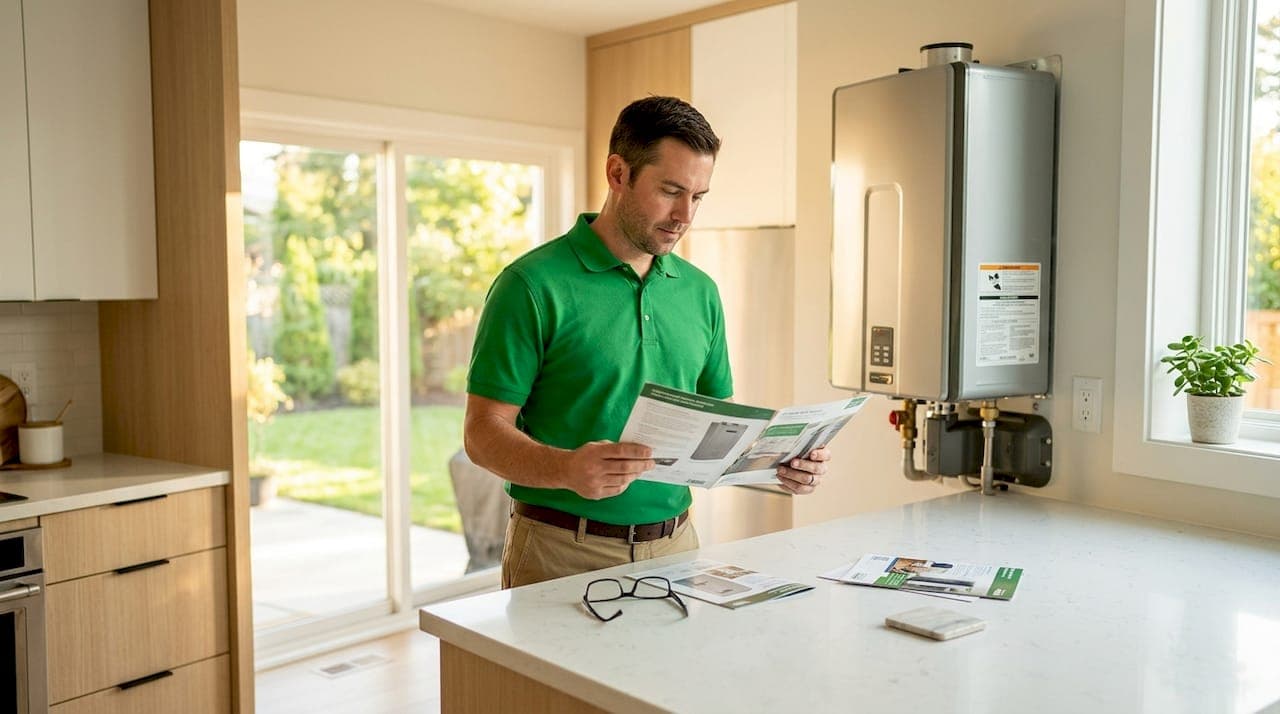
When your water heater starts failing, the pressure to replace it fast can push you into a bad decision. Knowing how to choose water heater replacement correctly means more than just picking the cheapest unit on the shelf. You need to match the right type, size, and fuel source to your home's actual needs. This guide walks you through every major decision point, from sizing and fuel type to installation prep and cost-saving incentives, so you can replace your water heater with confidence and avoid expensive mistakes.
Table of Contents
- Key takeaways
- How to choose water heater replacement by sizing correctly
- Types of water heaters and fuel sources
- Cost, incentives, and long-term savings
- Preparing for replacement: space, permits, and installation
- What to expect during and after replacement
- My honest take after years in the field
- Let Mgkplumbing handle your water heater replacement 🔧
- FAQ
Key takeaways
| Point | Details |
|---|---|
| Size by First Hour Rating | Match your unit to peak-hour demand, not just tank size, to avoid shortfalls or waste. |
| Compare all heater types | Tank, tankless, and heat pump units each have different costs, efficiency, and space requirements. |
| Stack financial incentives | Federal tax credits up to $2,000 and local rebates can dramatically cut your upfront cost. |
| Permits are not optional | Most jurisdictions require permits for water heater replacement, even a like-for-like swap. |
| Hire a licensed plumber | Professional installation protects your warranty, meets code, and prevents safety hazards. |
How to choose water heater replacement by sizing correctly
Most homeowners focus on tank size in gallons. That's the wrong starting point. The metric that actually matters is the First Hour Rating, or FHR. The FHR combines stored volume with the heater's recovery rate to tell you how many gallons it can deliver in the first hour of heavy use. That's the number you need to match to your household's peak demand.
To estimate your peak-hour demand, think about your busiest morning. Count the number of showers, dishwasher cycles, and laundry loads that run simultaneously. Each shower uses roughly 10 gallons, a dishwasher cycle uses 6, and a clothes washer uses 7. Add those up and you have your target FHR.
| Household size | Estimated peak-hour demand | Recommended FHR |
|---|---|---|
| 1 to 2 people | 30 to 40 gallons | 40 to 50 gallons |
| 3 to 4 people | 50 to 60 gallons | 55 to 70 gallons |
| 5 to 6 people | 65 to 80 gallons | 75 to 90 gallons |
A typical family of four needs an FHR of 50 to 60 gallons. Here's something that surprises most people: a 50-gallon gas water heater with a 40,000 BTU burner can deliver an FHR of around 80 gallons, outperforming a 75-gallon electric tank in real-world use. Recovery rate matters more than raw tank volume.
Going too big wastes energy. A 75-gallon tank wastes money heating water you never use. Going too small means cold showers by the second person in line. Get the FHR right first, then select your unit.
Pro Tip: Ask your plumber to pull the FHR off your old unit's label before removal. Compare it to your current household size. If your family has grown or shrunk since the original install, this is your chance to right-size.
Types of water heaters and fuel sources
Once you know your FHR target, you can select hot water heater type and fuel source. Each option has real trade-offs in cost, efficiency, and installation complexity.
Tank water heaters
Tank units store a fixed volume of hot water and reheat it continuously. They are the most affordable upfront and the simplest to install. Gas models heat faster than electric, which gives them a higher FHR for the same tank size. Electric resistance tanks cost less to purchase but more to operate monthly.
Tankless water heaters
Tankless units heat water on demand with no standby heat loss. That sounds ideal, but there are real constraints. Tankless heaters require high electrical service, often 100 or more amps at 240 volts for whole-home electric models. In cold climates like the Carolinas in winter, their effective output drops because the incoming water is colder and requires more energy to heat. You can explore tankless water heater services if you want to know whether your home's infrastructure supports one.
Heat pump water heaters
Heat pump water heaters (HPWHs) pull heat from surrounding air and transfer it to the water. They are two to four times more efficient than standard electric tanks. The Uniform Energy Factor for HPWHs ranges from 3.0 to 4.0 or higher, compared to about 0.9 for a standard electric tank. The trade-off is space. They require at least 450 cubic feet of ambient air and produce noise around 45 to 55 decibels, similar to a quiet dishwasher. Place them in a garage, basement, or utility room away from bedrooms.
| Heater type | Upfront cost | Efficiency | Best for |
|---|---|---|---|
| Gas tank | $600 to $1,200 | Moderate | High demand, gas available |
| Electric tank | $400 to $900 | Lower | Simple replacement, low demand |
| Tankless gas | $800 to $1,800 | High | Unlimited demand, adequate gas line |
| Tankless electric | $700 to $1,500 | High | Small households, strong electrical |
| Heat pump | $1,000 to $2,000 | Very high | Mild to warm climates, large savings |
Pro Tip: Your local utility rates and climate are the two biggest factors in choosing the best water heater option for your home. If your electricity rate is below $0.12 per kilowatt-hour, a heat pump unit pays back faster. If you're in a colder region, look for HPWHs rated for low ambient temperatures.
Cost, incentives, and long-term savings
Upfront cost is only part of the picture. The best water heater options for your budget account for installation, operating costs, and available incentives together.
Here's a realistic cost breakdown for common replacement scenarios:
- Gas tank replacement: $600 to $1,200 for the unit plus $200 to $500 for labor
- Electric tank replacement: $400 to $900 for the unit plus $150 to $400 for labor
- Heat pump installation: $1,000 to $2,000 for the unit plus $300 to $800 for labor and possible electrical upgrades
- Tankless installation: $800 to $1,800 for the unit plus $500 to $1,500 for labor and infrastructure upgrades
Federal incentives change the math significantly for heat pump models. Under the Inflation Reduction Act, you can claim 30% of installed cost for a qualifying HPWH, capped at $2,000 per year through 2032. That credit reduces what you owe in taxes directly. Many local utilities in North and South Carolina also offer rebates on top of that. Stacking a $2,000 federal credit with a $300 utility rebate can bring a $1,800 heat pump unit down to an effective cost below a standard electric tank.
The long-term savings are real. Switching to a heat pump water heater saves $300 to $600 per year on energy bills. Over 15 years, a four-person household can save nearly $9,000 in energy costs compared to a standard electric tank.
Pro Tip: Before you buy anything, visit the Database of State Incentives for Renewables and Efficiency (DSIRE) at dsireusa.org to find every rebate and credit available in your zip code. Some utility programs require pre-approval before purchase, so check first.
New plug-in 120-volt heat pump models are now available, making them viable retrofit options in homes without a dedicated 240-volt circuit. That removes one of the biggest installation barriers. Check our coupons and specials page for current promotions on water heater installation in the Charlotte and Rock Hill area.
Preparing for replacement: space, permits, and installation
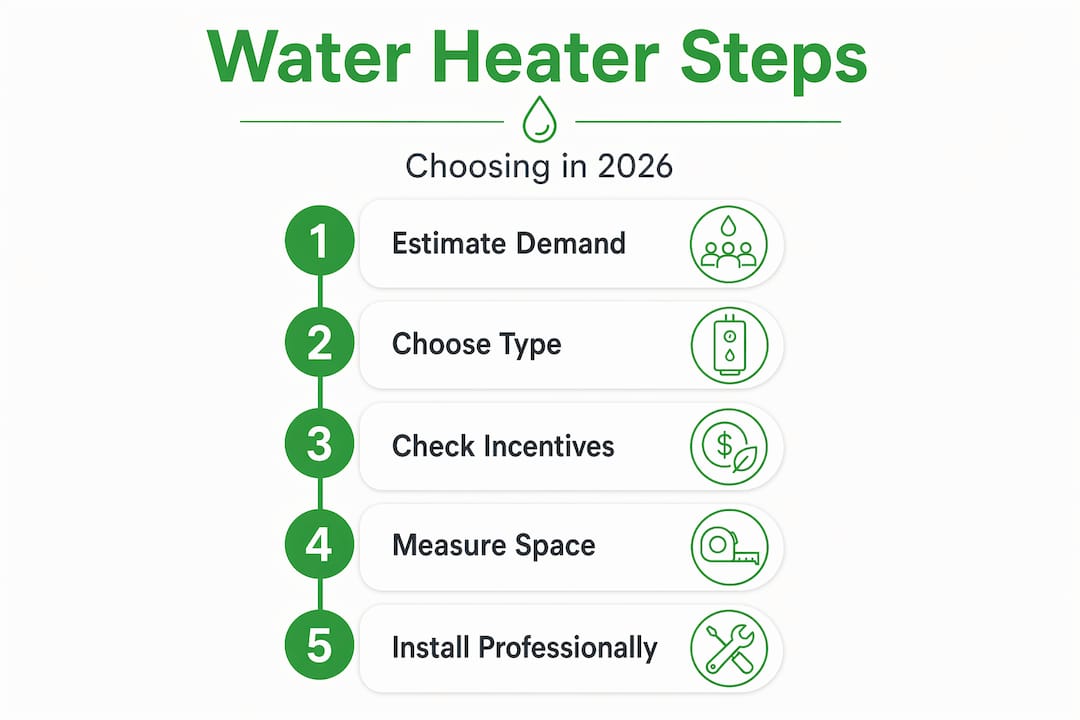
Before any unit ships to your door, you need to do some homework. Skipping this step is where most homeowner headaches start.
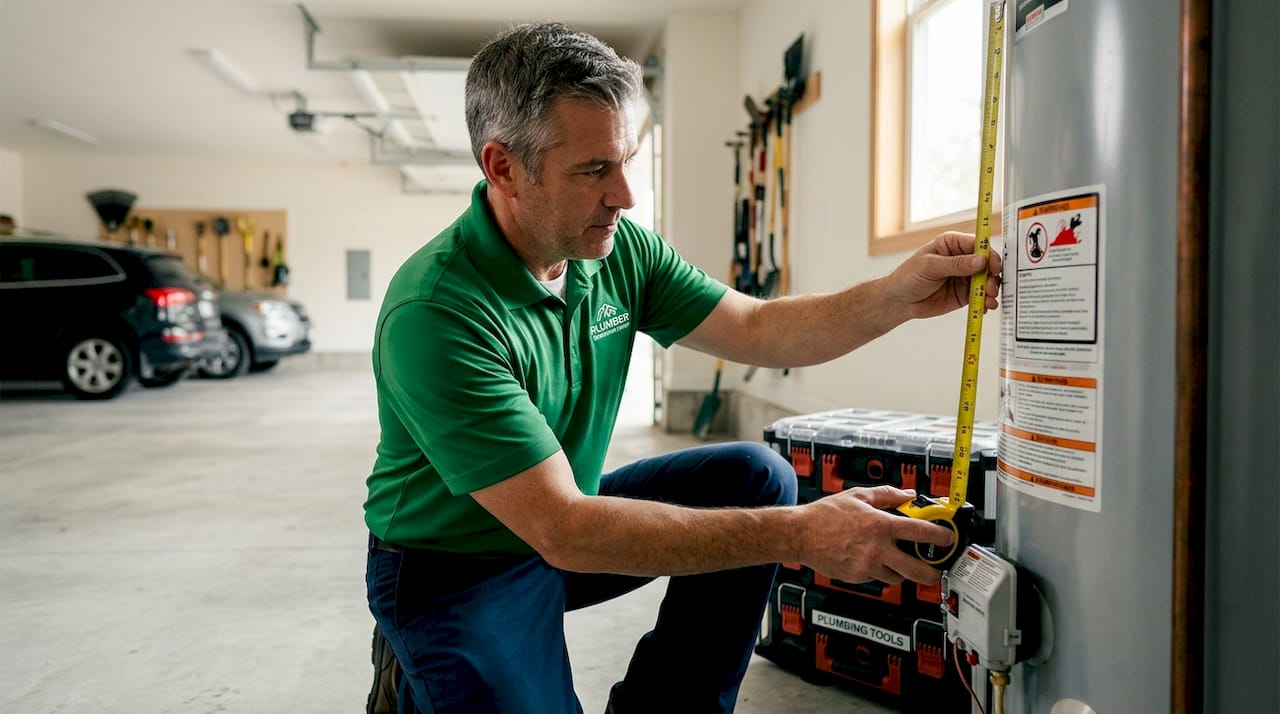
Start by measuring your current unit's footprint and the available clearance around it. Heat pump models are taller and wider than standard tanks. They also need air volume, temperature thresholds, and condensate drainage to operate correctly. If your utility closet is tight, a heat pump may not fit without relocating the unit.
Permits matter more than most people realize. Many homeowners skip permit requirements for replacements, assuming it's a simple swap. That's a mistake. Unpermitted work can void your homeowner's insurance, cause problems at resale, and leave you liable if something goes wrong. Most jurisdictions in North and South Carolina require a permit for water heater replacement.
Here's a pre-installation checklist to review with your plumber:
| Item | Why it matters |
|---|---|
| Space and clearance | Confirms unit will physically fit and meet code clearances |
| Electrical panel capacity | Verifies available amperage for electric or heat pump models |
| Gas line size and pressure | Required for gas tank or tankless gas units |
| Condensate drain access | Needed for heat pump models |
| Expansion tank present | Required on closed plumbing systems |
| Permit pulled | Protects warranty, insurance, and resale value |
Professional installation by a licensed plumber is not just a convenience. It's protection. Improper installs commonly miss expansion tanks on closed systems or vent gas units incorrectly. Both are code violations and safety hazards. Code compliance and warranty protection depend on getting this right the first time.
Pro Tip: If your home was built before 2000, ask your plumber to check whether you have a closed plumbing system. These systems require an expansion tank alongside the new water heater. Missing this is one of the most common installation errors.
What to expect during and after replacement
Knowing how to replace water heater properly means understanding the full sequence. Here's what a professional installation looks like from start to finish:
- Shut off utilities. The plumber turns off the gas or electricity and the cold water supply to the existing unit.
- Drain the old tank. Water is drained through a hose to a floor drain or outside. This can take 20 to 45 minutes for a full tank.
- Disconnect and remove the old unit. Gas lines, electrical connections, and water lines are disconnected. Old units are heavy. A licensed team handles disposal or recycling.
- Prepare the installation space. Any needed upgrades to electrical, gas lines, or venting happen at this stage.
- Install the new unit. The new heater is set in place, connected to water lines, fuel source, and any required components like expansion tanks or condensate drains.
- Fill, test, and commission. The tank fills with water before power or gas is turned on. The plumber checks all connections for leaks, tests the temperature and pressure relief valve, and confirms proper operation.
- Set the thermostat. The recommended setting is 120 degrees Fahrenheit for safety and efficiency.
After installation, watch for these signs of a successful job:
- No visible leaks at connections or the pressure relief valve
- Hot water reaching target temperature within the expected recovery time
- No unusual odors from a gas unit after startup
- Consistent water temperature at fixtures throughout the home
Pro Tip: Flush your new tank-style water heater once a year to remove sediment buildup. Set a calendar reminder. This single maintenance step can add years to the unit's lifespan and keep efficiency high.
My honest take after years in the field
I've seen the same pattern repeat itself dozens of times. A homeowner buys the biggest tank they can find, assuming more is always better. Then they call us six months later wondering why their energy bills jumped. Oversizing wastes energy and costs real money every month. Right-sizing based on FHR is the move, not guessing big.
Heat pump water heaters have changed the game for homeowners in the Carolinas. I've watched clients go from skeptical to converted after their first full year with a HPWH. The savings are not theoretical. They show up on the utility bill every single month.
The one thing I push back on hardest is DIY installation. I understand the appeal. But I've seen what happens when an expansion tank gets skipped, a TPR valve gets installed wrong, or a gas vent gets routed incorrectly. Those aren't just code issues. They're safety hazards. The permit and the licensed installer are not upsells. They're the reason your warranty stays valid and your family stays safe.
Balancing upfront cost with lifetime value is the real water heater buying guide that nobody talks about. A $400 unit installed wrong costs more than a $1,200 unit installed right.
— Mike Knight
Let Mgkplumbing handle your water heater replacement 🔧
Choosing the right water heater is only half the job. Getting it installed correctly by a licensed professional is what protects your investment.

At Mgkplumbing, we are licensed, bonded, and insured in both North and South Carolina. Our team handles every type of water heater replacement, from standard gas water heater installation to high-efficiency heat pump and electric water heater services. We pull permits, handle disposal of your old unit, and make sure everything is code-compliant from day one. We also offer honest, upfront pricing with no surprises. Check out our full residential plumbing services or call us today to schedule your replacement consultation. 🏠
FAQ
What is the First Hour Rating and why does it matter?
The First Hour Rating tells you how many gallons of hot water your heater can deliver in the first hour of peak use. It combines tank size with recovery rate and is the most accurate way to match a water heater to your household's actual demand.
How much does water heater replacement cost in 2026?
Replacement costs range from $550 to $3,300 depending on the type and installation complexity. Heat pump models cost more upfront but qualify for federal tax credits up to $2,000 and typically save $300 to $600 per year on energy bills.
Do I need a permit to replace my water heater?
Yes, most jurisdictions in North and South Carolina require a permit for water heater replacement. Skipping the permit can void your insurance coverage and create problems when you sell your home.
Is a heat pump water heater worth it in the Carolinas?
For most homeowners in the region, yes. The mild climate is well-suited to heat pump operation, and the combination of federal tax credits and local utility rebates makes the payback period much shorter than in colder states.
Can I replace my water heater myself?
Technically possible in some cases, but not recommended. Improper installation can void your warranty, fail code inspection, and create gas or electrical hazards. A licensed plumber handles the permit, the safety checks, and the code compliance that protect your home and your family.